Meditation Contemplation and Facebook

Fr. John McNeil S.J.

Father John McNeil, S. J. saved my life in the early 1970s and, nearly four decades later, blessed it. He was unaware of our first encounter, but not of the second.

In the late 1960’s—1968 to be exact—my bride Georgia and I moved to New York with visions of Broadway dancing in our heads. Were it not for Georgia I would never have had the courage to leave home (Denver) and pursue my dreams—dreams that I assumed were our dreams. I am indebted to her forever.

In 1973, Georgia asked for a divorce (in our therapist’s office), which completely blindsided me, as I had spent months planning a celebration of our fifth wedding anniversary.

I was left alone in the room with the elephant of my thus far unexpressed homosexual desires. Good Catholic boy that I was, I had never acted on them. Georgia and I lived in the West Village blocks from the Stonewall Inn and adjacent to Greenwich Avenue, at the time, the biggest cruising street in Manhattan. With my hand on a bible I can swear that it never occurred to me that those men were looking at me.

Without the vows I had made to God and Georgia, I was defenseless against my desires and, in no time at all, I was behaving like a kid in a candy store—and Manhattan, in those days before AIDs, was some candy store!

I went to confession and told a priest that I had had intimate relations with another man and I didn’t know what to do.

“It’s too late to do anything,” was his less than compassionate reply, “You’ve already done it!”
Continue reading

Turner Classics – May’s Medication

Recently I’ve noticed a series of public services announcements promoting “device free dinners.”

They put me in mind of my double-bill for May’s Pick(s) of the month: “I Remember Mama” and “Meet Me in St. Louis.” The disappearing ritual of family dinner is central to both films.  All movie schedules are for Turner Classic Movies.

I REMEMBER MAMA: MAY 14, 8:00 EDT

MEET ME IN ST. LOUIS: MAY 9, 6:00 PM EDT

Both films take place in the first decade of the 20th Century; before the United States became a player on the world’s stage. Both celebrate family life in an era before Sigmund Freud pathologized parents; before John Bradshaw pathologized childhood (contemporary pediatricians would have a field day diagnosing and prescribing for Tootie, the youngest child in Meet Me in St. Louis); before peculiar relatives were branded as dysfunctional instead of being lovingly accepted as eccentric; and before the phrase “family values” became a politically divisive cri de coeur.

Continue reading

Dreams of Glory

The Lenten season led me to an uncomfortable examination of my life. Not that anyone’s examination of their life is meant to be comfortable. I’ve poured over the classic texts of a number of wisdom traditions and have never found any that proclaimed, “Blessed are the comfortable,” or “Thou shalt be comfortable.” Quite the contrary.

In the spirit of the season, I attended a day-long retreat entitled Responding to Fear and the Crises of our Time with the Spirituality of Francis of Assisi and Thomas Merton, led by Franciscan friar, Father Daniel P. Horan, OFM—more about that a little further on.

By the end of the retreat, my mind was going a hundred miles an hour (when I open my eyes in the morning, it’s usually idling somewhere between 35 and 40 MPH—ask anyone who has been in my vicinity when I awaken). I had just a few hours to calm down before going to the theatre with friends

I’m not entirely unused to such leaps of culture and consciousness.

Continue reading

Somebody Ought To Do Something

I recoil from sentences that begin, “Somebody ought to . . .” I cringe in much the same way I did in school when someone made the chalk squeak on the blackboard. People I don’t know, or people I do know and don’t especially care for, put forth such sentences at large family gatherings, such as holiday dinners, when nerves, at least mine, are already on edge. The phrase is usually a preamble to someone’s opinion about what’s wrong with the world and what needs fixing. Seldom, if ever, have I heard a speaker offer to participate in the solution to the problem they have presented.

I can think of one exception.  LeMond/Zetter, the talent management company I once worked for, represented an actress named Holland Taylor. You may know her as the narcissistic mother on the sit-com, Two and a Half Men.

In the early 1990’s, Ms. Taylor was convinced by old friends to accept a series regular role on their new television comedy. Once the show was in production, Ms. Taylor discovered that, week after week, the writers were giving her nothing to do. She asked for a meeting with the writers and her old friends, the show’s producers.

Continue reading

Happy Saturday

“Always be on the lookout for the presence of wonder.” – E. B. White

Saturdays I run errands—the post office, the bank, the dry cleaners, the pharmacy– if I need to refill prescription, and the library—if I need to pick up or return books. As I go about my errands, my radio is tuned to KPCC-FM the equal to if not the superior to any public radio station in the nation.

Last Saturday I was in a particularly good mood; the day before, the Republican majority House had been soundly defeated in its attempt to dismantle Obama care.

Continue reading

Turner Classic Movies – My Pharmacy of Choice

After spending the last two weeks writing about Appalachian poverty and the mediocrity of Paul Ryan, I was increasingly irritable and somewhat depressed.

So I’m turning this week to, what for me is, a fool-proof anti-depressant: Turner Classic Movies (link to schedule).  *To the best of my knowledge all of the recommended films are also available on DVD.

As I lost myself in the schedule of up-coming films my irritability and depression evaporated so I plan to use the last blog of each month to preview the best of TCM’s up-coming selections. There is such an abundance of great classic films each month that there isn’t enough room to write about them all—and I’ve seen them all, multiple times—really I have!  Several are easily worth an annual visit. In choosing the films for each month, I’ve chosen to go with the ones that may not be as well known.

Continue reading

I Take Paul Ryan Personally

High Toned Mediocrity or I Take Paul Ryan Personally

“If a brother or sister has nothing to wear and no food for the day, and one of you says to them, ‘Go in peace, keep warm, and eat well,’ but you do not give them the necessities of the body, what good is it?”  James 2:15-16

On Sunday March 12, I attended Eucharist at All Saints Church in Pasadena, CA. I went especially to hear guest preacher, Reza Aslan, the Muslim scholar and author of Zealot, The Life and Times of Jesus of Nazareth. (Amazon link to book)

Mr. Aslan preached on the Letter of James (James, a First Century Saint for the Twenty-first Century) and he did not disappoint. You can watch his entire homily here.

A few excerpts:

“James’s community referred to itself collectively as “the poor”. That’s right. The very first term to designate the followers of Christ was not “Christian” it was “the poor.”

“So we shouldn’t be surprised by James’s epistle’s overwhelming focus on the poor. What is perhaps a little more surprising is its bitter condemnation of the rich and powerful.

“Now this condemnation of wealth and power may seem extreme but the truth is that James is merely echoing the words of his brother who said “Woe to you who are rich, for you have received your consolation. But woe to you who are filled now, for you will be hungry. Woe to you who laugh now, for you will grieve and weep.” (Luke 6: 24-25)

Let’s be honest; this part of Jesus’s message has never been all that popular. Certainly not with the wealthy and powerful no matter how much they say the love Jesus. Not this part.

How else to explain politicians like Republican congressman Roger Marshall whose rationale for repealing the affordable care act and thus denying health care to millions who could not otherwise afford it, was to shrug and claim, “Like Jesus said, ‘the poor will always be with us.”

“How else to explain religious right leaders like Franklin Graham who justified the president’s Draconian regulations on immigration into the U. S by arguing that, ‘Well, God also does extreme vetting about who he allows to spend eternity with him, so why can’t the U. S. do the same?’ By the way I have a feeling that Franklin Graham is going to be surprised by the nature of God’s extreme vetting.”

On this point I think Pope Francis is correct when he said that “It’s hypocrisy to call yourself a Christian and chase away a refugee, or someone seeking help, or someone who is hungry or thirsty, to toss out someone who is in need of help. . . . It is better to be an atheist than a hypocritical Christian.”  (Here’s a link to Pope Francis’s homily.)

Continue reading

Making the Poor Visible

“Obamacare replacement hits Trump voters hard. Some of the biggest losers in Republican plan are in counties that supported him”

Headline in the Los Angeles Times, Sunday, March 12, 2017.

In the late 1990’s someone published a business motivational book called, “Who Stole My Cheese?” It remained on the NY Times best-seller list for almost five years.

My take away was that the difference between rats and people is this. There are five tunnels; only one of them has cheese. Both rats and people will, soon, after discovering the tunnel with cheese, return to it repeatedly. However, if the cheese is moved from, say tunnel two to tunnel five, the rats will return to tunnel two a few times until they realize there is no longer any cheese down that tunnel. Then, the rats will begin to explore the other four tunnels until they find cheese. Human beings, on the other hand will go down tunnel two until they starve because it is the right tunnel.

I was reminded of this business fable several times as I read the NY Times best-seller, Hillbilly Elegy: A Memoir of a Family and Culture and Crisis by J. D. Vance. The book, which many critics have hailed as a key to understanding the “Trump voter,” follows Vance’s life through a harrowing boyhood and adolescence amongst his hillbilly relatives to his enlistment in the United States Marine Corps to his undergraduate studies at the University of Ohio until, finally, his graduation from the Yale University School of Law. His story is more than a little bit Dickensian.

The book is well-written, reportorial and compelling. It more than likely fulfills the criteria of Joseph Campbell’s “hero’s journey.” I recommend it highly; like James Baldwin’s books it, too, is a guide for pilgrims who are willing to make the journey to an unfamiliar world. I underlined so many passages that it might be easier to pick out the passages that weren’t underlined.

Continue reading

Confessions of an Unrepentant Out-of-the-Closet Chick Flick Lover

In the February 3, 2017 issue of the New York Times, the estimable Gloria Steinem published an Op-Ed piece called “Women Have Chic Flics; What About Men?”

I say estimable because I have long admired Ms. Steinem. I first became aware of her, not from her article about being an under-cover Playboy bunny, and my respect for her predates the publication of MS Magazine’s inaugural issue. It was her 1968 interview with Pat Nixon.

In 1968, newly transplanted from Denver Colorado to New York City, I became (and still am) a regular reader of New York magazine. Shortly before that year’s presidential election, the magazine published Ms. Steinem’s interview with the notoriously press-wary, Mrs. Nixon. After Mrs. Nixon responded to one of Steinem’s questions by saying that the woman she admired most was former first lady, Mamie Eisenhower, Steinem reports:

Continue reading

Tourists, Pilgrims & Other Travelers

takemoretimecoverlessground

“Take more time, cover less ground.”
-Thomas Merton

My father’s taste in art leaned toward landscapes of the southwestern desert, hand-woven Navajo rugs, Native-American pottery and beautifully detailed Hopi Kachina dolls.

In the late sixties when I was living in New York, my parents came to visit. I booked a room for them at the Warwick Hotel located down the street from the Museum of Modern Art (MOMA).

My wife and I had a studio apartment on West 76th between Broadway and West End Avenue. If the light was right and you squinted and you had a properly romantic view of life, you might have described our apartment as Bohemian. It wasn’t; threadbare would have been a more accurate description. Our neighborhood, which is now completely gentrified and pricy, was at the time called Needle Park; wasted addicts prowled the streets and needles and syringes were common in the gutters of the neighborhood. On the bright side, many artists, young actors, musicians and writers lived nearby. Rents were rent-controlled and cheap.

Continue reading

Learning to See As Another Sees

“Seeing comes before words. The child looks and recognizes before it can speak.


“But there is another sense in which seeing comes before words. It is seeing which establishes our place in the surrounding world; we explain that world with words, but words can never undo the fact that we are surrounded by it. The relation between what we see and what we know is never settled.”


–John Berger, Ways of Seeing

When I am asked what it is exactly that I teach, I say that I teach people to see. I use archetypes, myth, metaphor, and mostly film, to teach people how to see symbolically and impersonally.

Continue reading

Resilience

My favorite picture from the Women’s March; Janice Posikoff photographed by Jody Rogac for Time Magazine

My favorite picture from the Women’s March; Janice Posikoff photographed by Jody Rogac for Time Magazine

Janice Posikoff  “I’m here representing the territory of my mother, Lillian Posnikoff, from Alert Bay, Canada, and her ancestors, the Kwakwaka ‘wakw people’. “Can’t you feel what we’re getting out of this march? It’s unity, it’s solidarity, it’s everything that we all wanted. It’s sending the clear message that absolutely, absolutely, he’s not the popular president, and we’re going to fight every inch of the way, every time it looks like corruption is happening or injustice is happening, all of it.”

It seems to me that The Women’s March, January 21, 2017, which as far as I know, originated as a protest of and resistance to the policies of the president who had been inaugurated the day before, blossomed into a world-wide celebration of and call heard round-the-world to resilience.

Continue reading

Resentment & Resilience: Two Faces of America

It is impossible not to contrast the mood of the presidential inaugural on January 20 with the world-wide Women’s March that took place a day later.

In Time magazine’s coverage of the inauguration, David Von Drehle wrote, “Trump’s rallying cry was resentment: resentment of foreign governments and industries, resentment of elected leaders and faceless elites, resentment of the empty factories and haunted cities that define the American landscape as rendered by its new leader. ‘American carnage,’ is how he tallied it all up . . . .”

Another Time reporter, Karl Vick, described the Women’s March differently: “(protest) signs were as bawdily exuberant as the crowds, which inevitably skewed activist but included many who had never demonstrated before, and who experienced in the gatherings both a stirring well of fellow feeling and sudden momentum. . .  Many said it was the best they’ve felt since election day.”

signisaboutyou
Conversations, e-mails and Facebook posts from friends, family and clients who attended the marches continue to confirm the exhilaration and fresh hope that were born of this event.

Continue reading

Best 2016 Movies Part 2: Round-up

Hidden Figures & Fences

hiddenfiguresThe year brought a jackpot of outstanding films about people of color. In addition to Midnight, Loving and Queen of Katwe, there are Hidden Figures and Fences.
Don’t miss Hidden Figures! It is an old-fashioned (in the best sense) movie that will have you on your feet and cheering at the end. Writer/director Theodore Melfi (St. Vincent) uses a tried and true formula, one that the film’s distributor 20th Century Fox has used countless times since the 1930s: take three ambitious and talented women and intercut their stories as they pursue success in a particularly macho man’s world—NASA in the 1960’s. All three women are working mothers, two of them are married; one is a widow. In their fight for opportunities commensurate with their abilities, the three heroines don’t just have to battle sexism, but racism as well. The performances of the three leading women, Taraji P. Henson, Octavia Spencer and singer/musician Janelle Monae (also in Moonlight) are righteous, infectious and altogether jubilant. They are reluctantly supported by gum-chewing NASA program director, Kevin Costner. Kirsten Dunst and Jim Parsons are terrific as the heroines’ condescending antagonists and Mahershala Ali (also in Moonlight) is fine (as in “He’s So Fine”) as the persistent suitor of reluctant widow, Henson.

More about Hidden Figures

Continue reading

Best Movies of 2016 Part 1

So often the best works of art, the most grace-filled and transcendent, are nearly impossible to describe in such a way that more than handful of people will be drawn to see them. Walter Kerr, the theatre critic for the N. Y. Times, wrote that a “true work of art is suitable for contemplation;” that is, you can see it, read it or listen to it again and again and it remains timeless, always able to hold a mirror your soul.

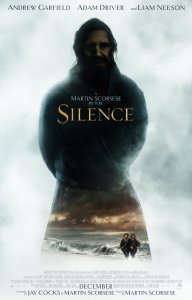
None of the films on my list are studio blockbusters; none of them are sequels; none of the stars (except, perhaps, Tom Hanks) guarantee ticket sales. All are worthy of repeated viewings; all are suitable for contemplation; none more so Silence.

Silence

silence2016There is a story told about the great Austrian composer, Gustav Mahler. Standing in the back of the concert hall during the premiere of one of his last works, Mahler is purported to have said, “I wish I could be alive in 50 years when the audiences will have learned to hear my music.”

The works of great artists are not simply entertaining; they are challenge the audience to and require its full engagement.

Visual and aural works that we regard today as masterpieces—the Impressionist painters, for example were, as often as not, ridiculed and dismissed by a majority of critics and viewers alike when they were first introduced.

Stephen Sondheim (now regarded, according to NY Times critic emeritus, Frank Rich, “as the greatest and perhaps best-known artist in the American theatre”) received praise for his intricate and witty lyrics during the early years of his career while, at the same time, his music was often dismissed as non-melodic and “un-hummable”.  As with Mahler, it took quite a while for audiences to be able to hear the beauty and variety in his musical scores.

Continue reading