Nostalgia Really Isn’t What it Used To Be

My cousin, Michael, and I don’t have occasion to interact very often—weddings and funerals, mostly.  I saw him last summer for the first time in several years at a mini family reunion that my sister hosted in honor of my 75th birthday and in honor of Michael’s older brother, Pat, an Oblate missionary priest in Africa, who was home on vacation.

Michael is a really good man. He and sister, Jane, have been, and continue to be, pillars of strength for their immediate and extended families throughout many heartbreaks, losses and tragedies that would have broken people of frailer character.

Michael and I are casual FB friends. His FB posts mostly tend toward nostalgic pictures from websites like the Good Old Days and Do You Remember the 60’s, 70’s and 80’s? My sister Mary posts pictures from these websites, too. They are occasionally funny, but in no way give me any desire to re-live those decades. Or the 50’s either!

Continue reading

Cognitive Dissonance and Conversion

st-teresa

In my last year of college (1963), Father Edward L. Maginnis S. J., the chairman of the theology department offered a seminar for seniors only. I don’t remember how the seminar was listed in the catalogue, but it was popularly known as “Can a Thinking Christian Be a Goldwater Republican.” This class had little to do with Barry Goldwater and everything to do with tweaking Edwin J. Feulner, the student body president who was a zealot and evangelist for the Goldwater brand of Republican conservatism. This was a somewhat quixotic endeavor to undertake on the campus of a Catholic men’s college during the Camelot years of John F. Kennedy’s presidency; the majority of students were resonating with Kennedy’s call to selfless service which aligned so perfectly with the principal raison d’etre of Jesuit education and formation: “to be a man for others.”

The key word in Father Magnnis’s course title is not, Christian, or Republican or even Goldwater; it is “Thinking”! Jesuits take some justified pride in teaching their students how to think thus abdicating forever the power to tell them what to think. Evidence of the Jesuits’ success and, perhaps, the mixed results can be found in the footnote.*

Continue reading

Artists, Saints and Prophets

hamiltonmusical

In the days immediately following Mike Pence’s attendance at the Broadway musical “Hamilton,” a friend of mine posted an article about the elegance of actor Brandon Victor Dixon’s address to the vice-president elect.

One of her friends replied that the address was inappropriate, rude and disrespectful. Another decried the lack of hospitality toward Pence: “people pay money to attend the theatre to relax and be entertained. They don’t go there to be made to feel uncomfortable.” I have a Master’s Degree in Theatre Arts and no instructor I ever had said anything remotely like that.

I replied to her post: “In the play “Inherit the Wind” a character based on legendary journalist, H. L. Mencken says, ‘It is the duty of a newspaper to comfort the afflicted and afflict the comfortable’. This is also the duty of art and artists and saints and martyrs. Early in the week the same friend who posted the article about Hamilton had posted a photo of a birthday card which featured a quote from Pope Francis, “Have courage! Go Forward! Make noise!” I referred to the card in my post, adding “that it seemed to me that this is exactly what the cast of Hamilton did.”

Comfortable art! Even “The Sound of Music” reaches its climax with Captain Von Trapp singing “Edelweiss,” and thereby risking his life to sing truth to power.

Continue reading

Mr. Smith Goes to Washington

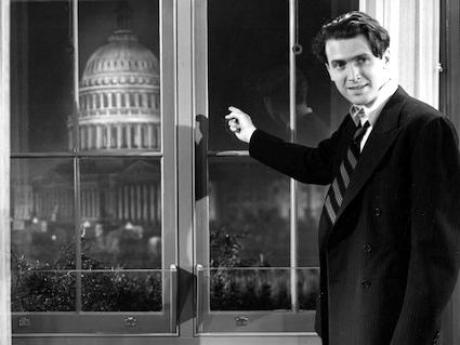
Jimmy Stewart in the 1939 film Mr. Smith Goes To Washington

Jimmy Stewart in the 1939 film Mr. Smith Goes To Washington

JEFFERSON SMITH – “Why don’t you people the truth for a change? People in this country pick up their papers and what do they read?

DIZ MOORE (a reporter) – “Well, this morning they read that an incompetent clown had arrived in Washington parading around like a member of the senate.”

JEFFERSON SMITH – “If you thought as much about being honest as you thought about being smart—“

DIZ MOORE – “Honest! We’re the only ones who can afford to be honest in what we tell the voters. We don’t have to be re-elected like politicians.”

I couldn’t have been more than 10 years old the first time my parents took me to see Frank Capra’s great film, Mr. Smith Goes to Washington.

The film was originally released in 1939, two years before I was born. We didn’t yet have television, let alone VHS, DVRs or Turner Classic Movies, but each year The Rocky Mountain News in collaboration with the Vogue, a small theatre in South Denver, sponsored a sort of film festival. The newspaper published ballots and readers could vote for the films they most wanted to see: the Marx Brothers, Fred Astaire and Ginger Rogers, W. C. Fields (with Mae West) and Frank Capra’s movies (Mr. Smith, Mr. Deeds Goes to Town and You Can’t Take it with You) always received enough votes to be screened. And my parents took me to see them.

Continue reading

Hightlights For Children, Melania Trump and my Sister Judie

highlightsThe magazine, Highlights for Children was ever-present in the doctors’ and dentists’ offices of my childhood. The magazine was filled with games and puzzles. One of my favorites was a puzzle called “What doesn’t belong?” There would be, for example, pictures of a car, a boat, a giraffe, a train and a plane. Which one doesn’t belong? Easy, the giraffe! This wasn’t a condemnation about the giraffe, simply recognition that a giraffe wasn’t a suitable vehicle for long-distance travel.

Shortly after the election, I re-posted another puzzle I saw on Facebook: Who doesn’t belong?” which showed pictures of three previous First Ladies—Eleanor Roosevelt, Jacqueline Kennedy and Nancy Reagan, a picture of the current First Lady, Michelle Obama, and the next First Lady, Melania Trump. The photo of Mrs. Trump was a nude photo. This was a judgment of Mrs. Trump, meant to ridicule and shame her and her husband and call attention to her unsuitability for the responsibilities of First Lady.

Almost immediately, I received this FB message from my middle sister, Judie. Judie, like Mary Poppins, is practically perfect in every way. (That’s neither a joke nor sarcasm, Judie really is practically perfect in every way; anyone who is lucky enough to know her will vouch for this.) Among her talents is an uncanny ability to channel our late mother. She wrote:

Continue reading

Finding God in All Things (Even this election)

This message was originally sent out to my newsletter subscribers but I was asked to post it as a blog as an introduction to this new section of my blog. 


A long overdue message in two parts.

finding-god-in-all-things


PART 1

I was fortunate to have an appointment scheduled with my spiritual director, on the afternoon of November 9, the day after the election. I had lost my grounding. I told my director that I needed guidance in how to accept and respond to what I view as a national tragedy.

I was a mess of feelings: heartbreak, disbelief, grief, anger, fear and disillusionment, to name a few.

My spiritual director is Jesuit-trained, as am I; St. Ignatius of Loyola, the founder of the Jesuits, guides his followers to see God in all things. A profound spiritual experience I had in the 1980’s showed me without doubt that everything is a gift, everything is grace.

Continue reading

The Archetypal Case for Hillary Clinton

hrd5


“So why is Clinton critiqued for raising her voice like Sanders, speaking hard truths like Biden, and making an awkward Pokémon Go reference we almost certainly would have dubbed a “dad joke” had Kaine said it? Why do we find their flaws likable and Clinton’s flaws off-putting? Why isn’t she seen as America’s awkward aunt or nerdy stepmom? I would argue it’s because we don’t yet have cultural touchstones for flawed but sympathetic women. We can recognize Sanders as a fiery activist, Biden as a truth teller, and Kaine as an earnest goof, but we just don’t have an archetype—fictional or otherwise—through which to understand Clinton.”    – Caroline Siede

After the primaries were over and the Democratic Convention had ended, several friends were disillusioned, bitter and, sometimes, inconsolable that Senator Bernie Sanders had lost the Democratic presidential nomination to Hillary Rodham Clinton.

This led me to explore the archetypal patterns of Sanders. Only later did it develop into a study of Hillary Clinton’s and Donald Trump’s archetypal make-up. (I will cover Trump’s archetypes in a separate piece.)

Continue reading

Archetypal America

In honor of the release of  the Archetypal America workshop recordings, I offer this post on one of my favorite films, Stagecoach. The course recordings can be purchased as a digital download here: https://gum.co/archetypalamerica

“The main American theme, I think, is freedom. It’s about individual freedom in opposition to or in tension with collective freedom.”  -Ken Burns, documentary film maker, “The Civil War”

Throughout American history the archetypes which populate our myths and legends and capture our imagination are the Rebel, the Revolutionary, the Liberator, the Scout, the Pioneer, the Cowboy, the Explorer, even the Outlaw: all of them perpetually moving forward in pursuit of their idea of freedom, both on behalf of the common good and at the expense of it. While many of these archetypes appear from the very beginnings of our history, the conflict between the various notions of freedom—personal and collective—solidified in the American psyche in the years leading up to and following the Civil War. They continue to impact us and our ideas of ourselves to this day. Few films capture these American themes and tensions as well as John Ford’s masterpiece, Stagecoach.

stage2

Stagecoach is high on my list of the 10 Best Movies of All Time. I’ve seen it at least 20 times, probably more. Without fail, something about it captures and holds with every viewing, so much so I save it on my DVR, along with Singin’ in the Rain and a few other films, so I can view them again whenever the mood strikes me.

Continue reading

A Conversation with Jim Curtan

This conversation is between Shane M. Nygaard and Jim Curtan on September 14, 2015, as part of the Minnesota Jung Association’s 2015-2016 season of event.

More information on Jim’s Workshop – Archetypal America October 23rd and 24th, 2015 in St. Paul, MN

SN:      Since you haven’t been in front of the Minnesota Jung Association (MJA) audience before, to help people get to know you a little before your visit, can you share a bit about your background?

Continue reading

Life Beyond A Crisis: Uncovering the Secret Next Chapter of our Lives

When: Saturday March 7th, 2015, 9am-3:30pm
Where: The historic campus of All Saints Church
132 N. Euclid Ave
Pasadena, CA 91101
Detail: People of all ages will learn about moving from crisis to re-birth, discovering a secret chapter to our lives, aligning with grace through chaos, navigating the unexpected, love and beauty at any age.
Fee: $58
Registration link

My first workshop of the year is sponsored by Stillpoint Center for Christian Spirituality and will be held at All Saints Church in Pasadena, one of the most beautiful venues in Southern California. I taught a workshop there last year about Pilgrimage using the film, The Way. We subsequently produced a self guided workshop based on that day long pilgrimage.

BEstI’m delighted to have been invited back for another workshop this year and I’ve chosen to focus on The Best Exotic Marigold Hotel.

Part of my inspiration for the course came from something a good friend said to me while we were having lunch about ten years ago. He was a few days shy of his 80th birthday and while we were sipping wine and waiting for our entrees to arrive he leaned in close to me and said, “You know the mid-life crisis? You have another one to look forward to.” I’ve never forgotten his remark and as I approach the half-way mark of my eighth decade, I’ve begun to watch for signs.

“When old words dies on the tongue, new melodies break forth from the heart;
and where old tracks are lost, new country is revealed with its wonders. “
– Rabindranath Tagore

I believe that’s why the film The Best Exotic Marigold Hotel has been so popular with viewers—so unexpectedly popular, in fact, that a sequel is set to be released the first week in March. The film captures its main characters deep in the throes of this crisis. It’s most marked characteristic is the shocking revelation that their identities, the life narratives they’ve carefully crafted for themselves are way past their “sell-by” date and they find themselves confronted by the need to discover new meaning, new purpose for their lives.

I hope you will be able to join me. Please do share this information with your friends in the LA area or those who might want to escape the cold to enjoy some Southern California sunshine next month. There is even a Facebook Event created to make it easier to share with your friends.

When: Saturday March 7th, 2015, 9am-3:30pm
Where: The historic campus of All Saints Church
132 N. Euclid Ave
Pasadena, CA 91101
Detail: People of all ages will learn about moving from crisis to re-birth, discovering a secret chapter to our lives, aligning with grace through chaos, navigating the unexpected and beauty and love at any age.
Fee: $58
Registration link

The Best of Movies 2014 – Part 1

When I began to reflect on the movies I’ve seen over the past year, I was surprised to discover that nearly all of them dealt with themes of Passion, the mystery of Vocation and Calling, Devotion and Duty—subjects that come up nearly every day in the conversations about discernment that I have as a spiritual director with my directees.


SELMA: Black Lives Matter

selmaIf you see only one film this year, make it Selma – a magnificent, conscience-challenging work, a worthy companion to last year’s Oscar winner for Best Picture, 12 Years a Slave. Ignatian prayer and contemplative practice, developed by St. Ignatius of Loyola, instructs meditators to place themselves in the scriptural passage with Jesus, just as if we were actually present at the event. Selma accomplishes just this placing viewers in the events rather than allowing us to be observers. The buffer of history that gave viewers some distance in 12 Years a Slave is not available here. Television coverage from Ferguson, MO and Staten Island, NY, as well as ongoing coverage of efforts to deny voter registration to minorities in many states, make the historic march from Selma to Montgomery seem like it happened yesterday rather than 50 years ago. Anchored by David Oyelowo’s galvanizing portrayal of Reverend Doctor Martin Luther King and directed by Ava DuVernay, it is a searing call to take action and an indictment against the injustices that continue to shame our nation. My African-American friends have repeatedly and patiently reminded me I can’t understand what it is like to live in a Black or Brown skin. Bearing helpless witness and burning with rage as Annie Lee Cooper (Oprah Winfrey in a wonderful cameo) maintains her dignity and resolve despite as she is repeatedly denied the right to register to vote may be as close as I ever come to understanding.

Check this link to read an excellent interview with the actor David Oyelowo about the impact that playing Dr. King on his own faith.

Charlie Rose’s interview with director Ava DuVernay is equally interesting.


IDA: In the Shadow of the Holocaust

IdaThe most profound and haunting film I saw this year was Ida by Polish director, Pawel Pawlikowski. Photographed in black and white, the images are austere and beautiful. The editing is designed to make us linger contemplatively over each scene, digesting it from the points of view of each of the main characters. Ida, a young postulate nun on the threshold of taking vows discovers she is, in fact, Jewish and one of only two members of her family to survive the Holocaust. Ida takes a leave from the convent to join her embittered aunt in a search for the truth about the death of their other family members. The sheltered Ida is introduced to a world of which she has no experience—a world that includes romance and sex, cowardice, heroism, disillusionment, despair and death. The camera stays on her mostly silent response to these events and as Ida discerns whether to return to the convent or stay in the world, the film superbly illustrates the grace and mystery of vocation.


CALVARY: The Sins of the Fathers

Calvalry_filmThe great Irish actor Brendan Gleeson (probably best-known to American audiences for his portrayal of Mad-Eye Moody in the Harry Potter movies) gives one of the best performances of the year as Father James, a priest in a seaside Irish village. The film opens in a confessional where Father James (a widower with an adult daughter who came late to the priesthood) is told under the seal of confession that, although he is personally innocent, that he will be murdered in seven days, as retribution for the unprosecuted sexual crimes committed against children by pedophile priests and covered up by church hierarchy.

The film follows Father James through each of the seven days as he encounters several of the villagers he ministers to and wonders along with the audience which of them passed sentence on him in the confessional. He wonders if he is actually of any use to them, wrestles with the temptation to flee and questions the responsibilities of his vocation—particularly compassion, forgiveness and faith in God, as the seventh day grows closer. The film skilfully balances suspense with characteristic Irish black humor and is populated by a wonderful supporting cast led by Chris O’Dowd (St. Vincent and Bridesmaids) and others recognizable from Masterpiece Theatre, Game of Thrones, etc.

Calvary is now available on demand through many cable companies and is also available on Amazon Prime.


THE GRAND BUDAPEST HOTEL: The Virtue and Vocation of Civility
Budapest-liftI enjoyed this movie when I saw it last summer but it didn’t stay with me like some of director Wes Anderson’s other films, particularly The Darjeeling Limited. Then, about a week ago I happened to catch the last 10 minutes of it while waiting for another program to begin on HBO.

In one of the final scenes a journalist asks the narrator, Mr. Moustafa about his relationship with the film’s hero, M. Gustave. Moustafa replies, “There are still faint glimpses of civilization in this barbaric slaughter house that was once known as humanity. He was one of them. . . You see, we shared a vocation. He certainly sustained the illusion with marvelous grace.” I had not caught the reference to vocation when I saw the film in the theatre. It intrigued me enough to watch the movie again on HBO. Seeing the film through the lens of shared vocation completely re-framed it for me.

M. Gustave, played by Ralph Fiennes (another Harry Potter alumnus Voldemort) is the manager of an elegant hotel in pre-war Eastern Europe whose life is dedicated to service, hospitality, good manners and civility.

Hospitality is thought to be the core virtue of all of the Abrahamic religions—Judaism, Christianity and Islam. Genesis 18 begins with a description of Abraham and Sarah’s warm hospitality, their welcoming of strangers.

The Grand Budapest Hotel, gorgeously designed and photographed, is both an elegy for the lost virtues of hospitality and civility and a moving plea for their return. This film, like Birdman which I’ll discuss in a later blog, is a fable and is photographed more like a fairy-tale than Into the Woods.


In upcoming blogs, I plan to write next about Birdman, Mr, Turner, Whiplash and Chef; Boyhood, Saint Vincent and Force Majeure (Turist), The Imitation Game and The Theory of Everything: The Lunchbox and Words and Pictures; Foxcatcher and Nightcrawler; Pride and Into the Woods.

A Few of My Favorite Things (Gift Guide)

This time of year I like to be even more mindful that usual of all of the blessings in my life. And I am blessed with extraordinary friends. Some of these friends bless me doubly and triply because they are also my teachers. Each has a body of inspiring and provocative work and I’d like to share some of my favorites with you.

All of these would make great holiday gifts for others or you may hint to others you would like some of these for yourself.

CAROLINE MYSS

My wonderful friend, teacher and author, Caroline Myss has written many wonderful books but I especially love her recordings. Unless you’ve been at some of Caroline’s recording sessions, you may not know that she doesn’t read from a text. Although she prepares in SpiritualMadnessadvance, she speaks ex tempore. This gives immediacy and intimacy to the recordings that puts her right in the room with me.

I first discovered Caroline and her work when I was diagnosed with cancer and came across her recording of “Why People Don’t Heal and How They Can.” The wisdom in that recording has guided me through 17 years of cancer treatments.

My personal favorite of all of Caroline’s recordings is “Spiritual Madness.” I don’t know how many times I’ve listened to it, but I always find something new with every listening.

A wonderful companion to “Spiritual Madness” is the lesser known “Your Primal Nature.” It’s fascinating.

All of these are available at www.SoundsTrue.com and Amazon/Audible

MARK MATOUSEK

wyfd_lg1I’ve known Mark Matousek since he was sixteen years old and was around him a great deal until he went away to school. He chronicles this part of his life in “Sex, Death, Enlightenment” one of the finest spiritual memoirs I’ve ever read. The follow-up memoir, “The Boy He Left Behind,” avoids the sophomore slump of many writers, and is, if anything, even richer than the first book. I have a particular bias toward his book, “When You’re Falling, Dive: Lessons in the Art of Living,” because I’m interviewed in it and that the interview put me in the company of Joan Didion, David Steindl-Rast, Dr. Rachel Remen and Bill McKibben.

Mark is also an exceptional teacher. He regularly offers a six-week on-line course called “Writing As a Spiritual Practice” and he’s just released a seven-part audio course called “What’s Your Story.” To find out more about Mark and his work visit him at www.markmatousek.com

WILKIE AU

EnduringHeartWilkie Au is a spiritual director’s spiritual director. I can say this with certainty because I have been blessed to have Wilkie as my spiritual director for over fifteen years. Alone, and with his wife, Jungian analyst and spiritual director, Noreen Cannon Au, Wilkie has written a quintet of invaluable spiritual guides, each of which focuses on a specific quality of developing a richer spiritual life and practice. If you are unfamiliar with their work, the two books I most recommend are “The Enduring Heart: Spirituality for the Long Haul” and “The Grateful Heart.” The former is a reassuring reminder that the essence of spiritual life is, like marriage, relationship. The latter is an activist’s handbook for living a life rooted in and committed to gratitude. For more information visit: http://wilkieandnoreenau.com/

ELLEN GUNTER

Earth-Calling-book-coverEllen Gunter is a woman on fire. She’s a prophet and gadfly. Her book, “Earth Calling” is an impassioned education and wake-up call about the multiple environmental crises that threaten the planet. What sets her book apart is that on every page you are reminded how much Ellen loves the earth. This book isn’t just good science, it’s a love letter. The book is available on Amazon.

RICHARD ROHR

Father Richard Rohr, OFM, is so prolific, it’s hard to settle on just a few recommendations. If you are unfamiliar with his work his three volumes of daily meditations—excerpts drawn from his books, articles, sermons and workshops—are like mini-anthologies which are wonderful in YesAndthemselves or may guide you toward one or another of his complete works. The three anthologies are “Radical Grace,” “Yes . . .And,” and “On the Threshold of Transformation: Daily Meditations for Men.”

Among Father Richard’s audios, I particularly like “True Self, False Self” and “Great Themes of Paul” (Richard’s series on Paul provides compelling evidence that Paul is a great mystic whose writings have  interpreted literally and damagingly. I’m not exaggerating when I say that I fell in love with the St. Paul revealed in these recordings. www.cac.org

JAMES FINLEY

James Finley was one of my teachers when I was  training to be a spiritual director and ContemplativeHeartbecame a colleague when we taught together at CMED.* I don’t know that there is any substitute for encountering James Finley in person. If you ever have the chance to spend a day, a weekend or a week in his company, sign up immediately. To find out about his retreat schedule check his website: http://contemplativeway.org/ . His book “Merton and the Palace of Nowhere” is a contemporary classic and essential reading for anyone interested in a deeper understanding of Thomas Merton’s teaching. James has collaborated on audio books and recorded seminars with both Caroline Myss and Richard Rohr. You can find them at either www.soundstrue.org or www.cac.org  Ally of them provide rich material for reflection and contemplation.

Happy Reading! Happy Listening!

Love,

Jim